Home › Services
EV charger installation for Danville and San Ramon Valley homes
A Level 2 charger turns your garage into the place your car fills up overnight, and in the San Ramon Valley that is how most EV owners end up charging. Getting there is mostly an electrical question rather than a gadget question: whether your panel has room for another large circuit, how far the wire has to travel from that panel to where the car parks, and whether the charger lives indoors or out in the weather. This page walks through Level 1 versus Level 2, hardwired and plug-in units, circuit sizing in plain terms, sharing power between two cars, permits and time-of-use rates, so you can read any quote for EV charger installation in San Ramon, Danville or Alamo with a sharp eye.
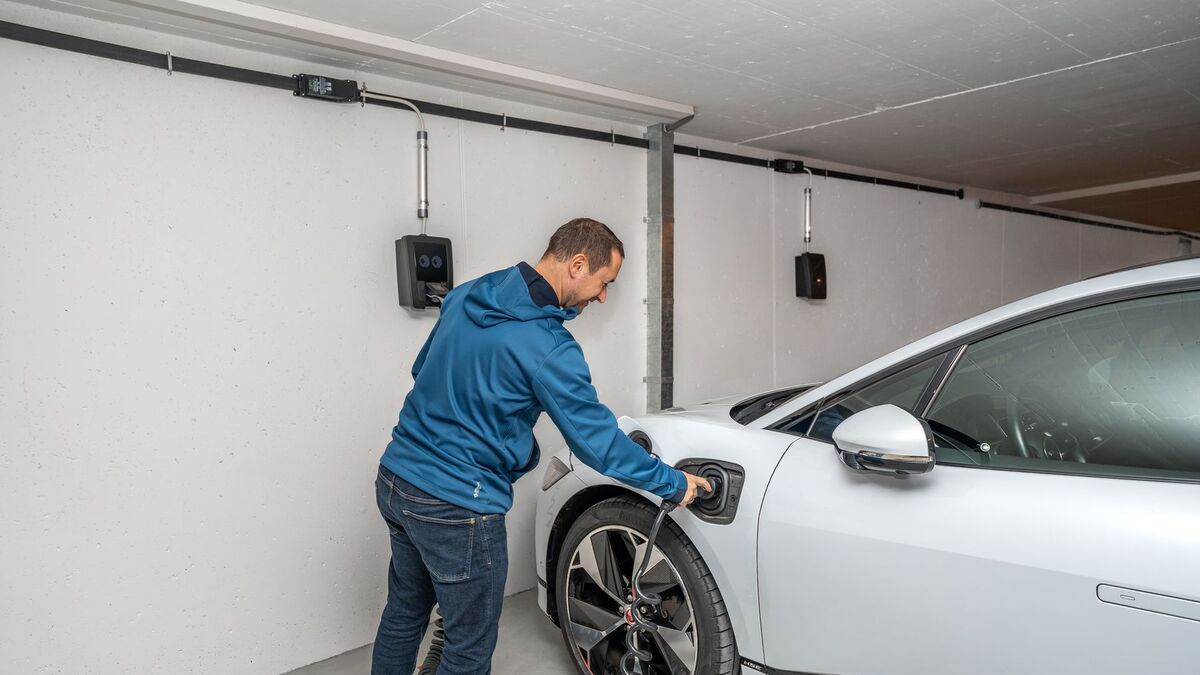
Level 1 versus Level 2: which one your driving actually needs
Level 1 means the cord that came with the car, plugged into an ordinary household receptacle. It adds only a few miles of range for every hour connected. That trickle can suit a plug-in hybrid, but a battery-electric car driven up and down I-680 every weekday usually falls behind.
Level 2 runs on a 240-volt circuit, the same kind of supply a clothes dryer or an electric range uses. It refills a typical daily commute in a couple of hours and a nearly empty battery overnight. The car sets its own ceiling on charging speed, so matching charger and circuit to the vehicle beats buying the biggest box on the shelf.
Hardwired chargers and plug-in chargers each have a place
A plug-in Level 2 charger connects to a heavy-duty 240-volt receptacle mounted on the wall. You can unplug it and take it with you when you move, and swapping it for a newer model is simple. The tradeoff is the receptacle itself: under hours of continuous charging current, a cheap or loosely terminated receptacle can run hot, and the electrical code the state adopts expects ground-fault protection on many of these outlets in garages and outdoors, which adds a protective breaker to the job.
A hardwired charger has its supply conductors landed directly inside the unit. There is no plug to wear out, the installation is cleaner on an outside wall, and many hardwired models can be set to draw more current than their plug-in versions allow. Either way, the unit should carry a listing mark from a recognized testing laboratory; off-brand chargers sold online without one are worth skipping.
How the circuit gets sized, without the math
An EV charger is treated as a continuous load because it can pull its full rating for hours on end. The code therefore requires the breaker and the wire to be sized with headroom above what the charger actually draws, so nothing runs near its limit all night. The electrician reads the charger's rated current, applies that margin, and picks a breaker and conductor size to match.
Many chargers have an internal setting, a dial or an app menu, that tells the unit what size circuit it is connected to. That setting must match the breaker that was installed. If it is set higher than the circuit, the charger will happily overload it. A careful installer sets it on the spot and records the value.
Panel capacity is the question that decides the price
Before anything else, the electrician looks at how much spare capacity your existing service has. A typical San Ramon Valley house built in the 1970s or 1980s may already be feeding central air, an electric dryer, a pool pump circuit and perhaps a newer heat pump water heater. Adding a large charger circuit on top of that is where a load calculation comes in: a structured estimate of how much the house draws at its busiest, compared against what the service is rated to deliver.
If the numbers work and the panel has physical breaker spaces, the job stays simple. If spaces are full, tandem breakers or a small subpanel are sometimes options, depending on what the panel's labeling permits. If the calculation shows the service itself is too small, the conversation moves to a bigger service, which is covered on the electrical panel upgrades page. Ask first about the load-management options below, which often avoid it.
Load management and power sharing for a two-EV household
Two electric cars in one driveway is common across Danville, San Ramon and Blackhawk, and two full-power chargers running at the same moment can be more than a modest service can carry. There are several ways to handle it without doubling the load on the panel.
- Power-sharing chargers: two units from the same maker talk to each other and split one circuit's capacity, giving each car half when both are plugged in and full power to whichever one is alone.
- Charger-level load management: a current sensor clamped on the service conductors tells the charger how much the rest of the house is using, and the charger throttles back when the oven, dryer and air conditioning are all running.
- Energy management devices or smart panels: equipment that watches the whole service and sheds or limits selected loads, an approach the code recognizes when the device is listed for that purpose.
- A lower setting on one circuit: a second charger configured at a reduced current still refills most commutes overnight and may fit where a full-power circuit would not.
Garage, carport or driveway: choosing where the charger goes
The best location is usually the one that keeps the cord short and the wire run short at the same time. Note which side the charge port sits on and whether the cord would cross a walkway.
An attached garage that shares a wall with the panel is the easiest case. When the panel is on the far side of the house, the wire may travel through the attic, along the crawlspace or in conduit on the exterior, and each route changes labor and material.
Reaching a detached garage means trenching and a feeder
Hillside lots in Alamo, Diablo and parts of Danville often put the garage well away from the house, sometimes down a slope or across a patio. Getting a charger out there means running a circuit, or a feeder to a small subpanel, underground. The trench depth depends on the wiring method and what lies above it, and the electrician follows the code requirements for that method rather than digging to a guess.
Before any digging, underground utilities must be marked through the regional call-before-you-dig service, and irrigation lines and landscape lighting cables get located by hand. Clay soils common in the valley hold up a trench wall but turn heavy when wet, so digging is easier in the dry months. Crossing a concrete walk may mean boring under it or saw-cutting and patching.
Outdoor chargers and the weather the East Bay throws at them
Summers inland of the hills get hot, winter brings soaking rain, and an outdoor charger lives through all of it. Equipment mounted outside should carry an enclosure rating suited to rain and dust, and the connection points need weather-resistant fittings and conduit sealed so water does not wick into the box. Direct afternoon sun on a dark housing can push some units into reduced output on the hottest days, so a shaded wall beats a south-facing one when there is a choice.
A receptacle used outdoors for a plug-in unit needs an in-use cover that stays closed while the plug is inserted. A holster at a comfortable height keeps the connector off the ground and out of sprinkler spray.
Permits and inspection for a home charger
Installing a new 240-volt circuit for an EV charger is permitted work in nearly every jurisdiction. In Danville the application goes to the Town of Danville; elsewhere in the valley it goes to the city or to Contra Costa County, depending on which agency covers the address.
The permit triggers an inspection, where the inspector checks breaker and conductor sizing, grounding, the charger's mounting, any ground-fault protection, and the labeling on the panel. A complete installation proposal states plainly who pulls the permit and that the price includes inspection. A quote that suggests skipping the permit is a warning sign.
Time-of-use rates and charging overnight
PG&E offers residential rate plans built around time of use, including plans aimed at households with electric vehicles. The general idea is that electricity costs less late at night and more in the late afternoon and evening when demand peaks. The details, hours and tiers change from time to time, so check PG&E's current offerings for your account rather than relying on anything printed here.
Either the car or the charger can hold a schedule so charging starts once the cheaper window opens. Use one scheduler, not both, or the two timers can block each other. Coordinating a charger with batteries and backup equipment is covered on the backup power and generators page.
What a complete EV charger quote spells out
A useful proposal lets you compare quotes line by line.
- Whether the charger is supplied by the contractor or by you, with the make and model named.
- The breaker size, conductor type and size, and the route the wire will take from panel to charger.
- The result of the load calculation and whether any load management device is part of the plan.
- Any panel work, subpanel, trenching, boring or patching, each listed as its own line.
- Permit, inspection and any utility coordination, with who is responsible for each.
- How the charger's current setting will be configured and documented.
- Workmanship coverage terms on the installation, separate from whatever the charger maker offers on the unit.
What drives the cost of installing a home charger
There is no single price for EV charger installation, because the work behind the wall changes from house to house. The main drivers are the distance from panel to charger, the wiring route and how much finished drywall or stucco sits in the way, whether the panel has spare capacity and breaker spaces, whether trenching or a subpanel is involved, the charger chosen, and the permit itself. The contractor prices the job after seeing the panel and the parking spot. To get that started, send the address and a few photos of the panel, its label and the place you want the charger, and mention whether a second EV is on the horizon. Serving San Ramon? The San Ramon page covers local conditions there.
EV charger installation for Danville and San Ramon Valley homes — common questions
Do I need an electrician to install a Level 2 charger at home?
Yes. A Level 2 charger needs a dedicated 240-volt circuit run from your panel, sized with a margin above the charger's draw, terminated correctly and inspected under a permit. That is electrical work on the house wiring, not a plug-and-go accessory. Even plug-in Level 2 units need a properly installed heavy-duty receptacle on its own circuit. What you can do yourself is choose the charger, measure where the car parks and photograph the panel so the electrician can scope the job quickly.
Can my 100 amp panel handle an EV charger?
Often it can, but only a load calculation answers it for your house. Many smaller services have enough headroom for a charger set at a moderate current, especially when the home uses gas for heat, cooking and drying. Where the margin is thin, a charger with built-in load management or a separate energy management device can watch total household use and slow charging when demand peaks. A service upgrade becomes the answer mainly when the house is already heavily electrified or a second high-power charger is planned.
How long does it take to install a home EV charger?
The physical work for a straightforward garage install near the panel is often done within a single day. Longer runs through finished spaces, a subpanel or a trench to a detached garage add time. The bigger variable is usually scheduling the permit inspection with the local building department, and, if a service upgrade turns out to be needed, coordinating with PG&E. The contractor can give you a realistic sequence after seeing the site, but timing depends on agencies outside anyone's direct control.
Is it better to hardwire an EV charger or use a 240-volt outlet?
Hardwiring removes the receptacle as a point of wear and heat, suits outdoor mounting better and lets many chargers run at their highest setting. A receptacle makes the charger portable and easy to replace, which appeals to renters or people planning to move. If you choose a receptacle, insist on a heavy-duty, industrial-grade device rather than a bargain one, and expect the code to require ground-fault protection at that outlet. For a permanent outdoor install, most electricians recommend hardwiring.
Can I charge two electric cars on one circuit?
With the right equipment, yes. Some charger brands let two units share a single circuit and divide its capacity automatically, giving each car half when both are connected and full power to one car charging alone. Overnight, that split usually still refills two daily commutes. The alternative is two separate circuits, which needs more panel capacity and possibly load management. Choosing a sharing-capable charger at the first install makes adding the second car later far simpler.
Should an outdoor EV charger in the driveway be mounted on a post or the house wall?
A house wall is simpler and cheaper when it sits within cord reach of where the car parks, because the circuit can often stay above ground in conduit. A pedestal post makes sense when the car parks away from the house, when two parking spots need to share one charger, or when the wall is mostly glass or doors. A post usually means an underground run to its base, with trenching and a concrete footing. Either way, pick an enclosure rated for outdoor exposure.
Talk through your site
Start with the address, what you want done, and a few photographs of the area, including anywhere water sits after a heavy rain.
Related work
Electrical Repair
Dead outlets, tripping breakers, flickering lights, warm switches and the faults behind them.
Electrical Panel Upgrades
Service and panel upgrades for EV charging, heat pumps, remodels and aging or problem panels.
Lighting Installation
Recessed, pendant, under-cabinet, landscape and outdoor lighting, dimmers and controls.
Home Rewiring
Replacing aging, undersized or damaged wiring in older houses, room by room or whole-house.
Backup Power and Generators
Standby generators, transfer switches and battery-ready wiring for shutoffs and outages.
Across the metro
San Ramon
Planned neighborhoods from the 1970s onward, newer communities to the east and a lot of EV demand.
Alamo
Large-lot hillside homes, older custom houses, long service runs and outdoor lighting.
Blackhawk
Big newer homes on the slopes of Mount Diablo with large loads, gated access and backup power.
Walnut Creek
Postwar ranch houses beside newer infill, older panels and a steady stream of remodels.