Home › Services
Home rewiring for older Danville and San Ramon Valley houses
A lot of houses around Danville went up between the 1960s and the 1990s, and the wiring inside those walls was sized for a household that ran one television, a toaster and a window fan. Today the same circuits carry home offices, induction cooktops, heat pumps and a car in the garage. Rewiring is the job of replacing that aging, undersized or damaged cable with new runs, new boxes and new devices -- sometimes for one room, sometimes for the whole house. Below: the warning signs, partial versus whole-house work, getting new wire into finished walls, permits, and what a proposal should spell out. To get your own house evaluated, the contact page accepts the property address along with pictures of the panel and outlets.
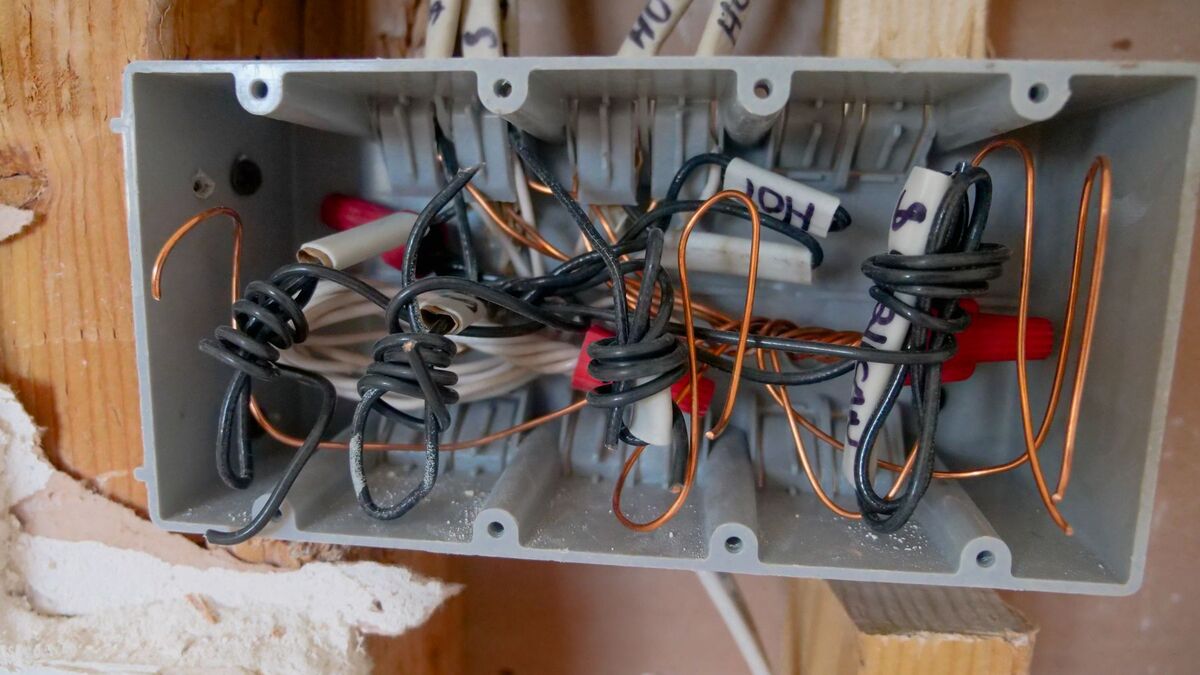
Signs your house is telling you the wiring has run its course
Old wiring rarely fails all at once. It gives hints for years -- a breaker that trips whenever the microwave and kettle run together, a bedroom with one outlet and three extension cords fanned out from it. Taken together, those hints describe a system never meant to carry today's load.
Some symptoms belong to a single failed device and are handled as a repair -- the electrical repair page covers that diagnosis. The signs below point past one bad outlet toward the cable itself:
- Two-prong outlets throughout the house, with no grounding conductor behind them.
- Cloth-wrapped or rubber-jacketed cable visible in the attic, basement or at the panel.
- Insulation that crumbles, cracks or looks scorched where it enters a box.
- Circuits that each feed several rooms, so one trip darkens half the house.
- Rooms that rely on power strips and extension cords for everyday use.
- Lights that dim noticeably when a large appliance or the HVAC kicks on.
- Previous owner add-ons: splices buried without boxes, mixed wire sizes, open junctions.
What you usually find behind the walls of a 1960s to 1990s valley home
The housing stock here is not one era, and the wiring changes with it. Many of the earliest ranch houses in the valley used two-wire cable without a ground. Homes from the late sixties and early seventies sometimes have aluminum branch circuits instead of copper. By the eighties and nineties, grounded copper cable was standard, but kitchens were wired for far fewer appliances, laundry rooms shared circuits with bedrooms, and garages got a single circuit that now has to share with a freezer, a workbench and a charger.
Remodels muddy the picture further: an updated kitchen can sit beside bedrooms still on original cable. So an electrician starts with a walkthrough -- checking the panel directory against what actually trips, looking into the attic and crawlspace, and testing outlets for ground and polarity -- to learn which runs are worth keeping.
Ungrounded outlets and cloth-insulated cable: what they actually mean
A two-prong outlet means the circuit has a hot and a neutral and nothing else. The missing equipment ground is the safe path that lets a fault trip the breaker instead of energizing a metal appliance case.
Swapping a two-prong outlet for a three-prong one without a ground behind it is a common shortcut, and it is a bad one: the outlet looks grounded and is not. The legitimate options are running new grounded cable, adding a separate grounding conductor where the electrical code the state adopts allows it, or installing GFCI protection and labeling the outlets as ungrounded. Which one fits depends on the room and on what will be plugged in.
Cloth-insulated cable is a different concern. Its rubber and fabric jacket dries out with age, and at light fixture boxes, where heat collects, it often turns brittle and flakes off the copper -- one reason rewiring replaces runs rather than patching them.
Aluminum branch wiring and the remediation options
For a stretch of years, some builders ran aluminum on small branch circuits. The trouble is at the connections: aluminum expands more than copper, oxidizes at the contact point and loosens under terminals designed for copper, and a loose connection runs hot.
If you suspect aluminum, look at the cable jacket in the attic or at the panel for printed markings, or ask an electrician to confirm it on a walkthrough. Do not pull outlets out of the wall to check. Remediation generally falls into three paths, and a proposal should say which one it is pricing:
- Full replacement of the aluminum branch circuits with new copper cable -- the most invasive and the most permanent.
- Connecting a short copper pigtail at every outlet, switch and fixture using connectors rated for joining aluminum to copper.
- Replacing devices with ones specifically marked for aluminum conductors, a narrower fix with real limits that an electrician can explain for your house.
Partial rewiring or the whole house: how to decide
Whole-house rewiring is not automatically the right answer. If the cable is grounded copper in decent shape and the problem is simply too few circuits, adding new runs to the kitchen, laundry and a couple of bedrooms may solve it. If the house has ungrounded cable in every room, brittle insulation at fixtures and a history of amateur splices, piecemeal fixes usually end up costing more over time than doing it once.
A few questions sharpen the choice. Is a remodel planned in the next few years? Rewiring while walls are already open is far cheaper than fishing wire through finished plaster later. Will the house add a heat pump, an induction range or a car charger? Those loads affect the service as well as the branch circuits, which the panel upgrades page explains. Is the house being sold? Buyers and their inspectors read old wiring as a cost, and a documented, permitted rewire answers the question before it is asked.
How new wire gets through finished walls without gutting the house
Most rewiring in occupied homes is done by fishing, not demolition. An electrician works from the attic and crawlspace, drilling through the top and bottom plates of each wall and pulling cable to outlet and switch locations with flexible bits, fish tapes and glow rods.
Fishing still leaves openings where a wall has fire blocking midway up or a run must cross a ceiling joist. Good installers line those small cuts up so patching is quick, and keep them clear of tile and built-ins.
Patching is its own trade. Some proposals stop at rough patching and leave texture and paint to a painter; others finish the wall to match. Either is fine as long as it is in writing.
Attics, crawlspaces, hillside lots and detached outbuildings
Access shapes the price of a rewire more than square footage does. A single-story ranch with a walkable attic and a tall crawlspace is the easy case; a low-pitch roof, a finished room over the garage or a partial slab forces more wire through walls the long way.
Hillside homes add split levels and partial crawlspaces that step down the slope. Detached garages, studios and workshops are common on larger lots, and they are often fed by an old underground run that was undersized from the start. Replacing that feeder may mean trenching across a yard, around landscaping and irrigation, and that is a separate line item worth seeing on its own.
Dedicated circuits for kitchens, laundry and the loads that came later
Rewiring is the natural moment to fix the circuit layout itself, not just the cable. Modern kitchens expect several countertop circuits so a toaster oven and a blender do not share with the refrigerator. Dishwashers, disposals and microwaves usually get their own. A laundry area wants a dedicated circuit for the washer, and an electric dryer needs a separate higher-capacity one. Bathrooms benefit from their own protected circuit for hair dryers and heaters.
Beyond the minimums, think about real use: a home office, a garage freezer, a pool pump circuit. Each is cheaper to plan now than to retrofit. If an electric vehicle is in your future, the EV charger installation page covers that circuit in detail; at minimum, a rewire can leave a clear path from the panel to the garage.
Permits, rough inspection and final inspection
Rewiring almost always needs a permit through the local building department -- the Town of Danville for addresses in town, or the city or county that covers your property elsewhere in the valley. The contractor pulls the permit, and the inspector is checking the work against the electrical code the state adopts, not grading the homeowner. A typical sequence runs like this:
- Walkthrough and scope, including which circuits stay and which are replaced.
- Permit application filed by the electrical contractor.
- Rough-in: new cable pulled, boxes set, connections left accessible.
- Rough inspection, while wiring is still visible at the access points.
- Devices, fixtures and breakers installed; circuits labeled at the panel.
- Final inspection and sign-off on the permit.
- Patching and cleanup, finished to whatever level the proposal promised.
Living in the house while it is being rewired
Clear closets and the space in front of outlets before the installers arrive, plan around pets and home-office days, and ask about the order of rooms so you can sleep in a finished bedroom while others are still open.
What a complete rewiring proposal should spell out
Two contractors can look at the same house and scope very different rewires. The cost drivers are access, the number of circuits and devices, the condition of what is being removed, patching level, and whether panel or service work is folded in. The electrical contractor prices it after seeing the house. A useful proposal names each of these items rather than giving one number for "rewire home":
- Which rooms and circuits are being replaced, and which existing runs stay.
- The count of outlets, switches, fixtures and new dedicated circuits.
- How aluminum, if present, will be handled, and by which method.
- Whether GFCI and AFCI protection is included where the code requires it.
- Any panel, subpanel or service work, listed as its own item.
- Patching scope: rough only, or finished and ready for paint.
- Permit handling and who meets the inspector.
- The workmanship coverage offered and what it applies to.
Start with a walkthrough and a few photos
If your house shows several of the signs on this page, the next step is a look from someone who does this work. Snap photos of the panel with the door open, a typical outlet, and anything visible in the attic, then send them with the address through the contact page. Homes across Alamo, Walnut Creek and the rest of the San Ramon Valley share many of the same wiring eras, and an electrical contractor working the region will follow up to arrange a visit.
Home rewiring for older Danville and San Ramon Valley houses — common questions
How do I know if my house has aluminum wiring?
The cable jacket usually tells you. In the attic, garage or near the panel, look for printing on the outer sheath that includes the letters AL or the word aluminum. You may also notice dull silver conductors where cable enters the panel, but leave the panel cover on and do not remove outlets to check. An electrician can confirm it during a walkthrough by opening a few devices with the power off and looking at the conductors and the terminals they connect to.
Is it safe to replace two-prong outlets with three-prong outlets?
Only if a ground is actually present or the replacement is done one of the accepted ways. Putting a three-prong outlet on a two-wire circuit with nothing connected to the ground terminal gives a false sense of protection. The accepted routes are running new grounded cable, adding a grounding conductor where allowed, or using GFCI protection with the outlet labeled as having no equipment ground. An electrician can test each circuit and tell you which path makes sense for each room.
How long does it take to rewire a house?
It depends on size, access and how much of the house is included, so any contractor quoting a firm schedule sight unseen is guessing. A few circuits might take a day or two of field work. A whole single-story home with good attic and crawlspace access takes considerably longer, and a multi-story house with limited access longer still. Inspection scheduling and patching add time on top of the wiring itself. Ask for a phased plan in the proposal so you know which rooms are affected when.
Do I have to move out while my house is rewired?
Usually not. Rewiring an occupied home is normal, and the work is typically sequenced so that a kitchen circuit, a bathroom and some lighting stay on overnight. You will deal with dust, drilling noise and periods without power in certain rooms. Households with someone who depends on powered medical equipment, or who works from home on tight deadlines, should raise that before scheduling so the order of work can be planned around it.
Will rewiring damage my plaster or drywall?
Some openings are almost unavoidable, but they should be small and deliberate rather than random. Most cable is fished from the attic and crawlspace, and holes are cut only where framing blocks the path. Lath-and-plaster walls are harder to fish through and crack more easily than drywall, which can raise the patching effort. Before signing, ask whether the price includes rough patching or a finished surface ready for paint, and whether the crew protects floors and furniture.
Does rewiring a house mean I also need a new electrical panel?
Not always. Rewiring replaces the branch circuits that run from the panel to outlets, lights and appliances. If the existing panel has room for the new circuits and is in sound condition, it can stay. If it is full, lacks space for arc-fault breakers, or comes from a brand with a poor track record, the proposal may recommend replacing it at the same time. Doing both together often saves duplicate permit and inspection steps.
Talk through your site
Start with the address, what you want done, and a few photographs of the area, including anywhere water sits after a heavy rain.
Related work
Electrical Repair
Dead outlets, tripping breakers, flickering lights, warm switches and the faults behind them.
Electrical Panel Upgrades
Service and panel upgrades for EV charging, heat pumps, remodels and aging or problem panels.
EV Charger Installation
Level 2 home charging: circuit sizing, panel capacity, load management and garage or driveway placement.
Lighting Installation
Recessed, pendant, under-cabinet, landscape and outdoor lighting, dimmers and controls.
Backup Power and Generators
Standby generators, transfer switches and battery-ready wiring for shutoffs and outages.
Across the metro
San Ramon
Planned neighborhoods from the 1970s onward, newer communities to the east and a lot of EV demand.
Alamo
Large-lot hillside homes, older custom houses, long service runs and outdoor lighting.
Blackhawk
Big newer homes on the slopes of Mount Diablo with large loads, gated access and backup power.
Walnut Creek
Postwar ranch houses beside newer infill, older panels and a steady stream of remodels.